Wednesday

Dieng Culture Festival-The Soul of Culture


Dieng Culture Festival  is the largest event held annually in the Tourism Dieng Area, at highland Dieng. As the name suggests is a cultural festival with the concept of synergy between the Culture Society, Nature Dieng potential and empowerment of local communities as the basic mission of the event.


Ritual Procession for Dreadlocks hair is a core event. The variety of events such as; jazzatasawan, film screenings, shadow puppets and other traditional arts, flying lanterns, fireworks, carnival culture, as well as exhibitions of handicraft products / creative industries and culinary of the highland Dieng.

Ritual of Dreadlocks Hair Boy have  purpose that aims to expel bad luck of the boy and society Dieng In general.


Dieng Culture Festival was first held in 2010. Previously, it is known as "Dieng Culture Week". When third year, the event changed its name into Dieng Culture Festival. The 7th Dieng Culture Festival (DCF) has been held for 3 (three) days from the date of August 5 to 7, 2016.


Thursday

Hombo Stone in NIAS


Fahombo, Hombo Stone or in Indonesian "Jump Rock" is a sport traditionally Tribe Nias . Exercise was previously a rite of passage Nias ethnic group is a lot to do in Nias Island and become a tourist attraction traditional strangest unique to the entire world.They must jump over the composition of the building stones as high as 2 meters with a thickness of 40 cm.

In the past, youth Nias will try to jump as high stone over 2 meters, and if they succeed they akaan into manhood and can join as soldiers to fight and get married. Since the age of 10 years, the boy on the island of Nias will be prepared to make a turn "fahombo" them. As a ritual, fahombo taken very seriously in the customary Nias. The boy would jump over the rock to get the status of their maturity, with fighters dressed in Nias, signifying that they were ready to fight and take responsibility for adult males.

Stones to be skipped in fahombo monument shaped like a pyramid with a flat top surface. Height not less than 2 meters, 90 cm wide and 60 cm long. Jumpers not only have to jump over piles of stones, but he also must have the technique for landing, because if he landed with the wrong position can cause muscl injuries or fractures. In the past, even a rock on a board covered with nails and stakes, which shows how serious this ritual in the eyes of Nias Tribe. Tactical battle, fahombo tradition also means training young warriors for agile and nimble in jumping over the walls of their enemy's defenses, with a torch in one hand and a sword in the evening

Come to NIAS and feel the fahombo spirit with jump up the stone.


Wednesday

Museum Batik Pekalongan


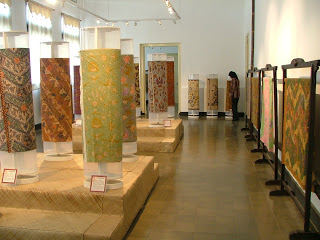
Museum of Batik Pekalongan was inaugurated by the 6th President of the Republic of Indonesia,  Susilo Bambang Yudhoyono on July 12, 2006. The museum building has an area of approximately 2.500 m2 on a land area of 3.675 m2. The building was a Dutch heritage building that has stood since 1906. This building has functioned as City Hall, the Mayor's Office, the sugar factory up until the municipal government office complex and ultimately Batik Museum.

Museum Batik Pekalongan has a lot of  batik  collection, the old  and modern batik from various Indonesian regions, from Java, Sumatra, Borneo, up to Papua.

Not only exhibiting a collection of batik,   Museum Batik Pekalongan also be a training center and learning center of making batik. Students and  visitors can learn to how to make batik or conduct research on the culture of batik.

Cooperation with some parties needed  to preserve the culture of batik. All done in accordance with the Batik Museum's commitment to continue to maintain and preserve the cultural heritage of high valued.


Museum Batik Pekalongan Address: Jl. Jatayu No. 3, North Pekalongan, Pekalongan, Central Java, Indonesia. Phone: (+62 0285) 431 698

Sunday

Angke Mangrove Nature Park in Jakarta


Mangrove Natural Tourism Park is one of tourism destinations which has nature theme in North Jakarta. This park is located in the north jakarta precisely in the residential area of Pantai Indah Kapuk (PIK). To access this location is quite easily, it could use a personal vehicle, taxi or public transportation from centre of Jakarta city.

Angke Mangrove Nature Park in Kapuk presents the beautifull natural  of a lake surrounded by a mangrove forest with an area of  approximately 90 hectares, making it the mangrove just like the Amazon forest in Jakarta.

There is a lake that surrounding mangrove which is quite spacious and clean, here we can enjoy the beauty of the lake while boating or canoeing. And other uniqueness of these places is visitors can walk on the wooden bridge which was built just above the lake.


The Mangrove Nature Park  is a conservation area managed by a private company. Decorated green clump of mangrove forests, the region is home to a variety of animals ranging from birds to lizards water.

Saturday

Tabuhan Island is Best Place For Kiteboarding?


Kiteboarding is a surface water sport combining aspects of wakeboarding, windsurfing, surfing, paragliding, and gymnastics into one extreme sport. A kiteboarder harnesses the power of the wind with a large controllable power kite to be propelled across the water on a kiteboard similar to a wakeboard or a small surfboard, with or without footstraps or bindings.  Kitesurfing is a style of kiteboarding specific to wave riding, which utilizes standard surfboards or boards shaped specifically for the purpose.

Tabuhan island in Banyuwangi, East Java, Indonesia is a sports tourism destination for Kiteboarding. There was held Tabuhan Island Kiteboarding Pro 2015, as a  Kiteboarding sport for tourism, followed by 55 participants from 20 countries.This event is the second time carried after last year.

Why Tabuhan Island, Banyuwangi is the best spot for kiteboarding? Because the wind speed around the island reach 20-25 knots constant throughout May to October. This wind speed was very good to play kiteboarding. Moreover, the sea around without waves.

This year Kiteboarding held 22 to August 23, 2015. Dozens of participants came from various countries, like the United States, Brazil, UK, Sweden, Finland, Netherlands, Lithuania, Poland, Russia, France, Spain, Germany, Austria, New Zealand, Australia, Thailand, Singapore, and China. This competition parade a number of styles in kiteboarding such as freestyle, free-ride, downwinders, speed, course racing, wakestyle, jumping, and kitesurfing.

Some kiteboarding world champion like Dan Sweeney (Freestyle Kiteboarding Champion from Australia), Narapichit Pudja (Runner-up World Champion and Asian Champion Race Race), and the Niklas Langseth (Champion Freestyle Kiteboarding Sweden) competed in the Tabuhan Island Pro in 2015.

You can join here,  to the Tabuhan island to play kiteboarding especially in May - August. Co-Host Tabuhan Island Pro Kiteboarding, Jeroen van der Kooij said that in here, is the better place to play kiteboarding than Bali. While in Bali, clear Van Der Kooij, the wind hardly ever blows at speeds above 15 knots.


How to get to the Tabuhan island ? From Banyuwangi city takes about 20 minutes to get to Bangsring Beach, one of the departure point to the Tabuhan.From Bangsring beach, you can go to Tabuhan island only less than 25 minutes using tourist ships operated by local residents.

Kalimutu Lake- The Lake With 3 Water Color


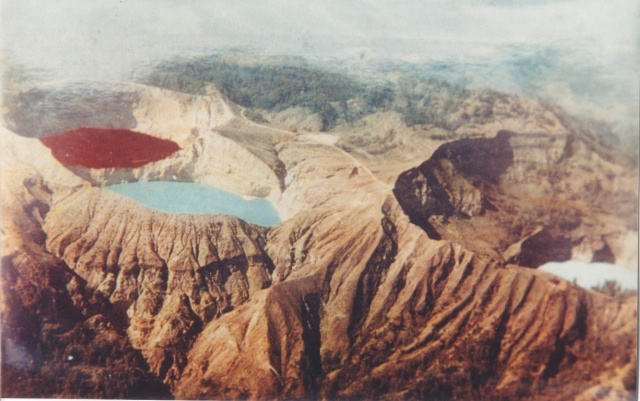
Kelimutu Lake is a crater lake situated on top Mount Flores (volcano). Mount Flores is located on the island of Flores, District Flores, Ende, East Nusa Tenggara Province, (NTT) Province, Indonesia.

Kalimutu Lake, better known as the Lake Three Colors. Discoloration on the three lakes is influenced by the activity of  volcanic mineral of Mount Kelimutu. Lake Ata Polo is lake which was originally green, then changed to a reddish brown color. Lake Nuamuri Ko'o Fai has a toska color turned into white milk. And the last lake, Lake Ata Mbupu recorded rarely changed its color, is now turning in to black from its original green color. Since 1915, the three lakes changes color several times, between 17-44 times.


Discoloration on the three lakes is just a scientific for fluctuations Kelimutu volcanic activity. According to records, this mountain has erupted terrific in 1830, several other eruptions also occurred in the early 1900s. Even the surrounding community trust, discoloration Lake Kalimutu is not only a common natural phenomenon, but also as an early sign of the occurrence of a something big.


Kete Kesu And Londa-Ancient Stone Graves In Toraja

The Toraja are an ethnic group indigenous to a mountainous region of South Sulawesi, Indonesia. Their population is approximately 1,100,000, of whom 450,000 live in the regency of Tana Toraja ("Land of Toraja").

The word toraja comes from the Bugis Buginese language term to riaja, meaning "people of the uplands". The Dutch colonial government named the people Toraja in 1909. Torajans are renowned for their elaborate funeral rites, burial sites carved into rocky cliffs, massive peaked-roof traditional houses known as tongkonan, and colorful wood carvings. Toraja funeral rites are important social events, usually attended by hundreds of people and lasting for several days

Tongkonan is the traditional ancestral house, or rumah adat of the Torajan people, in South Sulawesi, Indonesia. Tongkonan have a distinguishing boat-shaped and oversized saddleback roof. Like most of Indonesia’s Austronesian-based traditional architecture tongkonan are built on piles. The construction of tongkonan is laborious work and it is usually built with the help of all family members. In the original Toraja society, only nobles had the right to build tongkonan.

Kete Kesu is a tourist village in Tana Toraja region known for its traditional life of the community can be found in this region. There are many ancient relics such as stone graves were estimated age of 500 years in Kete Kesu are. In the stones graves that resemble a canoe or boat, saved the remnants of skulls and human bones. Nearly all the tomb stones placed hanging on the cliffs or caves.

Londa is a grave of the past were reserved for the nobility with two large caves that can be entered by visitors and the coffin containing human skulls.

There are many ancient tomb stones like this in Toraja. But the famous is Kete Kesu and Londa. Toraja is known with this stone grave.

One of the unique culture of Toraja is called Rambu Solo. Rambu Solo is a funeral procession Tana Toraja society, who do not like funerals in general. Rambu Solo is a ritual death of Toraja society which aims to honor and deliver the spirits of Toraja people who died toward the spiritual realm

Ma'tinggoro tedong (typical cutting buffalo by Toraja society, by slashing buffalo with a machete and only with a one single slash),  in ceremony Rambu  Solo.


How to get to Toraja? Flight from Jakarta to Makassar. Then use the bus to Toraja about 8 long hours journey.

Thursday

The Indonesia Philately Museum


The idea of holding a permanent exhibition of stamps in Taman Mini Indonesia Indah in Jakarta was expressed for the first time by Madam Tien Soeharto, wife of the second Indonesian President when she was visited the stamp exhibition that was held by Posts and Giro Public Corporation (now Pos Indonesia Inc,) on The 6th Asia Pasific Scout Jamboree that was held at Cibubur in June 1981

Indonesian Stamp Museum consist of eight show cases tells about: the History of stamps; The Stamp printing; The Stamp issued by period I & II; The Stamp by the Theme I & II; Philately; and Other Philatelic Items. Philately is a hobby of collecting, cure, and studying stamp and other things relation to stamps and payment of despatch, such as First Day Cover, Souvenir Sheet, Carnet, Maximum Card, Commemorative Cover, etc. If you want to complete your collections, we provide philatelic items here in Indonesian Stamp Museum

This museum is built on land with an area of 9,950 square metres on the right side of Komodo Museum and decorated with carvings in the styles typical of Bali and Java. On either side of the stamp Museum, there are two building of 204 square metres each for management office and Branch Post Office providing postal services to visitors and customers.

filateli.wasantara.net.id/NewTemp/Museum.htm


Saturday

Museum of The Asian-African Conference


The first large-scale Asian–African or Afro–Asian Conference—also known as the Bandung Conference—was a meeting of Asian and African states, most of which were newly independent, which took place on April 18–24, 1955 in Bandung, Indonesia.

The Asian-African Conference gained a big success both in formulating common concerns and in preparing operational guidance for cooperation among Asian African Nation as well as in creating world order and world peace. The conference has had a result Dasasila Bandung, which became the guideline for the colonized countries in fighting for their independence. It also became the fundamental principles in promoting world peace and international cooperation. The success of the conference was not only for the time being but also for the time after so that the soul and spirit of the Asian-African Conference becomes one of the most important factor that deciding world history.

All is a huge prestige that gained by the Asian African Nations. The spirit of Bandung had succeeded in widening the work volume among Asian African Nations. As a consequence, their influence and their role in international cooperation are increased and more respected. 
In order to maintain those mentions above, it is important if the Asian-African Conference with its event is maintained eternally in a museum where the conference was held, Gedung Merdeka, Bandung, a city that is considered as a capital city and a source of inspiration for the Asian-African Nations.

Inspired by desires to eternalize the Asian-African Conference, the idea of establishing a Museum of the Asian-African Conference in Gedung Merdeka was born by Prof. Dr. Mochtar Kusumaatmadja, S.H., LL.M.. The idea was delivered in the meeting of the Committee for the Commemoration of the 25th Anniversary of the Asian-African Conference (1980), which was attended by Directorate General of Culture, Prof. Dr. Haryati Soebadio as a representative for the Department of Culture and Education. Fortunately, the idea was fully supported including President of the Republic of Indonesia, Soeharto.

The idea of establishing the Museum of the Asian-African Conference had been materialized by Joop Ave, the Executive Chairman of the Committee of the 25th Anniversary of the Asian-African Conference and Director General of Protocol and Consular in the Department of Foreign Affairs in cooperation with Department of Information, Department of Education and Culture, the Provincial Government of West Java, and Padjadjaran University. The technical planning and its execution was carried out by PT Decenta, Bandung. 

The Museum of the Asian-African Conference was inaugurated by President of the Republic of Indonesia, Soeharto on 24th April 1980 as the culmination of the 25th Anniversary of the Asian-African Conference.

The Museum of the Asian-African Conference has a permanent exhibition room, which exhibits collections of three-dimensional objects and documentary photos of the preparatory Tugu Meeting, the Colombo Conference, the Bogor Meeting and the Asian-African Conference 1955.

The exhibition room also provides:
- the historical events that become the background of the Asian- African Conference;
- the effect of the Asian-African Conference to the world;
- Gedung Merdeka from time to time;
- Profile of participating countries of the Asian-African Conference performed in multimedia.

In the Museum has also a library provides books on the history, social, politics, and cultures of the Asian African Countries and others; documents of the Asian-African Conference and its preparatory conferences; magazines and newspapers donated by other institutions or gained through purchase.


Tuesday

9 famous temples in Indonesia

Borobudur Temple


Borobudur  is a 9th-century Mahayana Buddhist Temple in Magelang, Central Java, Indonesia. The monument consists of six square platforms topped by three circular platforms and is decorated with 2,672 relief panels and 504 Buddha statues. A main dome, located at the center of the top platform, is surrounded by 72 Buddha statues each of which is seated inside a perforated stupa. It is the world’s largest Buddhist temple, as well as one of the greatest Buddhist monuments in the world.

Prambanan Temple

Prambanan Temple Compounds consist of Prambanan Temple (also called Loro Jonggrang), Sewu Temple, Bubrah Temple and Lumbung Temple. Prambanan Temple itself is a complex consisting of 240 temples. All the mentioned temples form the Prambanan Archaeological Park and were built during the heyday of Sailendra’s powerful dynasty in Java in the 8th century AD. These compounds are located on the border between the two provinces of Yogyakarta and Central Java on Java Island.

Sewu Temple
Sewu is an 8th-century Mahayana Buddhist temple located 800 meters north of Prambanan in Central Java. Candi Sewu is actually the second largest Buddhist Temple in Indonesia after Borobudur. Candi Sewu predates nearby "Loro Jonggrang" temple. Although originally only around 249 temples are present, the name in Javanese translates to 'a thousand temples,' which originated from popular local folklore; The Legend of Loro Jonggrang. The original name of this temple compound is probably Manjusrigrha.

Mendut Temple

Mendut Temple is a Buddhist temple built by King Indra of Syailendra Dynasty. Mendut Temple niches became the throne for a large Buddha statue.
The temple is located about three kilometres east from Borobudur. Mendut, Borobudur and Pawon, all of which are Buddhist temples, are located in one straight line. There is a mutual religious relationship between the three temples, although the exact ritual process is unknown

Brahu Temple
Brahu temple is the biggest temple in Trowulan. Brahu is supposed come from “Wanaru” or “Warahu”, which is name of holly building that mentioned in a cooper inscription “Alasanta” that found in west side of this temple. Brahu temple is made of red bricks and plain without decoration. It is located in Jambu Menta sub-village, Bejijong village, Trowulan district, Mojokerto regency.

The temple that looks out on west is rectangle building with 22,5 m length, 18 m width, and 20 m height. Its building consist three part, which is foot, body and roof. Seen from its style, this temple is supposed to Buddha temple that built in 15 century. Based on Mpu Sendok inscription (861 Saka or 9 September 939 M), this temple is place to burn Kings Brawijaya death body (crematorium). But in some research, they never found any death body ash in the temple. The restoration of this temple is done in 1990 – 1995.

Banyunibo Temple

Banyunibo (Javanese: "dripping water") is a 9th-century Buddhist temple located in Cepit hamlet, Bokoharjo village, Prambanan, Sleman Regency, Yogyakarta, Indonesia. The temple, dating from the era of Medang Kingdom, sits in a narrow valley surrounded by paddy fields about two kilometers southeast of the Queen Boko archaeological park on the east side of modern Yogyakarta. Further north is the Prambanan temple, and to the south are the Gunung Sewu hills, extension of Gunung Kidul hills.

Cetho Temple
Ceto (Candi Ceto) is a fifteenth-century Javanese-Hindu temple that is located on the western slope of Mount Lawu  on the border between Central and East Java provinces.

Cetho is one of several temples built on the northwest slopes of Mount Lawu in the fifteenth century. By this time, Javanese religion and art had diverged from Indian precepts that had been so influential on temples styles during the 8-10th century. This area was the last significant area of temple building in Java before the island's courts were converted to Islam in the 16th century. The temples' distinctiveness and the lack of records of Javanese ceremonies and beliefs of the era make it difficult for historians to interpret the significance of these antiquities

Ngawen Temple
Ngawen (known locally as Candi Ngawen) is an 8th-century Buddhist temple compound in Magelang Regency, Central Java, Indonesia. Located in Ngawen village, Muntilan sub-district, 6 km (3.7 mi) to the east of Mendut temple or 5 km (3.1 mi) to the south of Muntilan town center. Ngawen temple compound consists of five temples, however today only one is successfully reconstructed.

Wednesday

The Charm of Old Town In The Middle of Modern City


If you love to see the old buildings, you should visit the old city. The city formerly known as Old Batavia is a small town located on the edge east of the Ciliwung River, Jakarta.
In the 16th century, the Old City of Batavia has become the main attraction for sailors and merchants from Europe. Legendary British explorer, James Cook even call this city as The Pearl of the Orient. Batavia city structure prepared to be a copy of the Dutch capital, Amsterdam so that it labeled Koningen van Oosten or Queen of the East.

The Old City Batavia has an harbor,  named Sunda Kelapa Port, and it become the forerunner of the city of Jakarta. It has 139 hectares area across North Jakarta to West Jakarta, this region is dominated by European and Chinese architectural buildings from the 17th century until the early 20th century. This area was expanded to 846 acres with a region that includes the port of Sunda Kelapa. But the core region itself includes the City Hall building or Fatahillah Museum and surrounding areas.

Before becoming the City of Batavia, this region was named Jayakarta (1527-1619) near the port of Banten Sultanate named Sunga Kalapa. This harbor was an inter-island trade area that has been initiated by the Kingdom of Sunda long before.

In 1610, the Dutch trading company- VOC (VerenigdeOostindische Compagnie) led by Jan Pieterzoon Coen attacked the port of Sunda Kelapa and Jayakarta. The VOC needed 30 years later to build a new city, named Batavia with the center is Taman Fatahillah. After the Japanese conquest of the city in 1942, the city changed the name into Jakarta.


The Old Town is still have areas where the building is still so genuine and no significant change since the days of the VOC. The Charming remind us of the history of our ancestors, your ancestors,  conquest by successive conquerors countries.

Saturday

7 Historical Fortress in Indonesia


There are many historic fortress in Indonesia that can be visited when you are traveling to Indonesia. who knows most of the existing fort  get in touch with your country and your history.

1.Fort Marlborough in Bengkulu

Fort Marlborough (Benteng Marlborough, also known as Malabero) is an English fort located in Bengkulu City, Sumatra, Indonesia. It was built between 1713-1719 by the East India Company under the leadership of Governor Joseph Collett as a defensive fort for theBritish Bencoolen. It was one of the strongest British fort in the eastern region, second only to Fort St. George in Madras, India.


2. Fort De Kock in West Sumatra


Fort de Kock is fort heritage Dutch are located in Bukittinggi , West Sumatra , Indonesia .
The fort was founded by Captain Bouer in 1825 at the time of Baron Hendrik Merkus de Kock as the commander of Der Troepen and Deputy Governor General of the Dutch East Indies, that's why this fortress known as the Fort de Kock. The fort is standing on the Mount Jirek and used by the Dutch Army as a stronghold of the onslaught of the Minangkabau people, especially since the outbreak of the Padri War in 1821-1837. 

Around the castle there are ancient cannons 19th century period subsequent years, Now, around this fort grow a city that is also named Fort de Kock, and this day known by Bukittinggi

3.Fort Somba Opu in South Sulawesi
Somba Opu is forts of Sultanate of Gowa built by King of Gowa-9, Daeng Matanre Karaeng Tumpa'risi 'Kallonna in the 16th century. The fort is located at Jalan Daeng Tata, Somba Opu, subdistrict Barombong , Gowa , South Sulawesi

4. Fort Inong Balee di Aceh.


The complex of Laksamana Malahayati’s grave is in Desa Lamreh, Kecamatan Mesjid Raya, Kabupaten Aceh Besar. As a symbol of respecting and the meaning of her war, its location is in hilltop and protected by wall. It’s winged and unwinged slab gravestone type with longfeet square. In her life, Laksamana Malahayati was known as a brave admiral when marched against Portuguese and Dutch in Malaka Straits. One of her great contribution was when she formed a single troop consists of some widows (known as Inong Balee and Benteng Inong Balee) fight against the imperialism.( Deni Sutrisna)

5. Fort Jagaraga di Bali.


The Fort Jagaraga is the fort of Balinese troops against the Dutch in the 19th century. In 1849 the peak of this fortress  occupation by the Dutch after a fierce battle between Bali fighters who tried to defend the Fort Jagaraga, with the spirit of Puputan War, until all the Bali's troops finally had fallen down. And the Dutch troops under the command of General Michaels took charge of  the Fort Jagaraga. Since 1849, kingdoms Bali became a part of the territory of the Dutch East Indies.

6. Benteng Duurstede di Saparua.


The fort is located in the town of Saparua, approximately 50 miles from Ambon. Dutch forts was built first in 1676 by Arnold de Vlaming van Oudshoor. The Fort Duurstede was used as the center of defense and government VOCs during occupied Saparua. The fort is also being a witness persistent struggle led by a Indonesian hero in 1817, he was Kapitan Pattimura.

The fort is quite unique, because the fort was built on the reef as high as 20 feet, it has 24 pieces of stairs to get into, and with the only  one entrance at the front. In front of the castle there is a well. The fort area is located at the edge of a white sandy beach with crystal clear water, beautiful scenery and vast Saparua sea can be enjoyed from this fort

7.  Fort Rotterdam, in Makassar

Fort Rotterdam is a fort built in Makassar on the island of Sulawesi in Indonesia. It was captured by the Dutch in 1667 and became a center of Dutch colonial power in Sulawesi. Following the Java War (1825–1830), Javanese prince, and now national hero, Diponegoro was imprisoned in the fort following his exile to Makassar in 1830 until his death in 1855. It was also used as a Japanese prisoner of war camp in World War II.

There are several modest museum exhibitions in various rooms in the Fort. Various local publications about South Sulawesi may also be purchased from a bookstore at the Fort.


Tuesday

Fatahillah Museum is a Historical Museum of Jakarta


Tour this time let's take a look a museums in Jakarta, Indonesia. Fatahillah Museum.

Fatahillah Museum  is the Jakarta Historical Museum, also known as  Batavia Museum, is located in the Old Town  of Jakarta, Indonesia. The building was built in 1710 as the Stadhuis (city hall) of Batavia. Jakarta History Museum, opened in 1974, displays objects from the prehistory period of the city region, the founding of Jayakarta in 1527, and through the Dutch colonization period from the 16th century until Indonesia’s Independence in 1945.

Fatahillah Museum occupies two long buildings in the old city area. This museum was formerly the town hall (stadhuis) builded in Batavia in 1707 by Governor-General Joan van Hoon. This building was completed in 1712. The architecture of the building like of the 17th century, the classical Baroque. This Museum has 3 floors with the main roof has a direction of the wind

The building contains 37 ornate rooms. There are also some cells located beneath the front portico which were used as dungeons. A Javanese freedom fighter Prince Diponegoro, who was treacherously arrested, was imprisoned here in 1830 before being banished to Manado, North Sulawesi.

This museum has an area of ​​more than 1,300 square meters. The front yard of Museum you can see few  of old trees. You can also see European style antique furniture from the 17th century. There are also collections of ceramics, pottery, and stone inscriptions. There are also various collections of Betawi culture, numismatic, and Becak.

The Jakarta Historical Museum has a collection of around 23,500 objects, some of them inherited from de Oude Bataviasche Museum (now the Wayang Museum). The collection includes objects from theDutch East Indies Company, historic maps, paintings, ceramics, furnitures, and archeological objects from the prehistoric era such as ancient inscriptions and sword. museum. Jakarta History Museum also contains the richest collection of Betawi style furnitures from the 17th to the 19th century. The collections are divided into several rooms such as Prehistoric Jakarta room, Tarumanegara Room, Jayakarta Room, FatahillahRoom, Sultan Agung Room, and MH Thamrin Room.

To improve the performance and appearance, the Jakarta History Museum since 1999 determined to make this museum is not just a place to care for, or exhibit collections from the Batavia, but also must be a better place for all people of Indonesia and foreign, children, people even for adults with disabilities to increase their knowledge and experience and can be enjoyed as a place of recreation. The Jakarta History Museum seeks to provide information about the history of the city from the begining, since prehistoric times to the present.

Address of Fatahillah Museum :
Jl. Taman Fatahillah No. 1 West Jakarta, Indonesia
Phon (62-21) 6929101, 6901483
Fax. (62-21) 6902387
email: musejak@indosat.net.id