Showing posts with label Temple. Show all posts

Tuesday

9 famous temples in Indonesia

Borobudur Temple


Borobudur  is a 9th-century Mahayana Buddhist Temple in Magelang, Central Java, Indonesia. The monument consists of six square platforms topped by three circular platforms and is decorated with 2,672 relief panels and 504 Buddha statues. A main dome, located at the center of the top platform, is surrounded by 72 Buddha statues each of which is seated inside a perforated stupa. It is the world’s largest Buddhist temple, as well as one of the greatest Buddhist monuments in the world.

Prambanan Temple

Prambanan Temple Compounds consist of Prambanan Temple (also called Loro Jonggrang), Sewu Temple, Bubrah Temple and Lumbung Temple. Prambanan Temple itself is a complex consisting of 240 temples. All the mentioned temples form the Prambanan Archaeological Park and were built during the heyday of Sailendra’s powerful dynasty in Java in the 8th century AD. These compounds are located on the border between the two provinces of Yogyakarta and Central Java on Java Island.

Sewu Temple
Sewu is an 8th-century Mahayana Buddhist temple located 800 meters north of Prambanan in Central Java. Candi Sewu is actually the second largest Buddhist Temple in Indonesia after Borobudur. Candi Sewu predates nearby "Loro Jonggrang" temple. Although originally only around 249 temples are present, the name in Javanese translates to 'a thousand temples,' which originated from popular local folklore; The Legend of Loro Jonggrang. The original name of this temple compound is probably Manjusrigrha.

Mendut Temple

Mendut Temple is a Buddhist temple built by King Indra of Syailendra Dynasty. Mendut Temple niches became the throne for a large Buddha statue.
The temple is located about three kilometres east from Borobudur. Mendut, Borobudur and Pawon, all of which are Buddhist temples, are located in one straight line. There is a mutual religious relationship between the three temples, although the exact ritual process is unknown

Brahu Temple
Brahu temple is the biggest temple in Trowulan. Brahu is supposed come from “Wanaru” or “Warahu”, which is name of holly building that mentioned in a cooper inscription “Alasanta” that found in west side of this temple. Brahu temple is made of red bricks and plain without decoration. It is located in Jambu Menta sub-village, Bejijong village, Trowulan district, Mojokerto regency.

The temple that looks out on west is rectangle building with 22,5 m length, 18 m width, and 20 m height. Its building consist three part, which is foot, body and roof. Seen from its style, this temple is supposed to Buddha temple that built in 15 century. Based on Mpu Sendok inscription (861 Saka or 9 September 939 M), this temple is place to burn Kings Brawijaya death body (crematorium). But in some research, they never found any death body ash in the temple. The restoration of this temple is done in 1990 – 1995.

Banyunibo Temple

Banyunibo (Javanese: "dripping water") is a 9th-century Buddhist temple located in Cepit hamlet, Bokoharjo village, Prambanan, Sleman Regency, Yogyakarta, Indonesia. The temple, dating from the era of Medang Kingdom, sits in a narrow valley surrounded by paddy fields about two kilometers southeast of the Queen Boko archaeological park on the east side of modern Yogyakarta. Further north is the Prambanan temple, and to the south are the Gunung Sewu hills, extension of Gunung Kidul hills.

Cetho Temple
Ceto (Candi Ceto) is a fifteenth-century Javanese-Hindu temple that is located on the western slope of Mount Lawu  on the border between Central and East Java provinces.

Cetho is one of several temples built on the northwest slopes of Mount Lawu in the fifteenth century. By this time, Javanese religion and art had diverged from Indian precepts that had been so influential on temples styles during the 8-10th century. This area was the last significant area of temple building in Java before the island's courts were converted to Islam in the 16th century. The temples' distinctiveness and the lack of records of Javanese ceremonies and beliefs of the era make it difficult for historians to interpret the significance of these antiquities

Ngawen Temple
Ngawen (known locally as Candi Ngawen) is an 8th-century Buddhist temple compound in Magelang Regency, Central Java, Indonesia. Located in Ngawen village, Muntilan sub-district, 6 km (3.7 mi) to the east of Mendut temple or 5 km (3.1 mi) to the south of Muntilan town center. Ngawen temple compound consists of five temples, however today only one is successfully reconstructed.

Saturday

Borobudur Temple


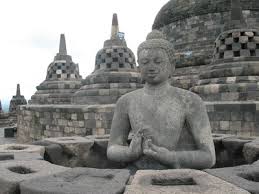
Borobudur is one of the greatest Buddhist monuments in the world. Founded by a king of the Saliendra dynasty, it was built to honour the glory of both the Buddha and its founder, a true king Bodhisattva. The name Borobudur is believed to have been derived from the Sanskrit words vihara Buddha uhr, meaning the Buddhist monastery on the hill

Borobudur, is a 9th-century Mahayana Buddhist Temple in Magelang, Central Java, Indonesia. The monument consists of six square platforms topped by three circular platforms, and is decorated with 2,672 relief panels and 504 Buddha statues. A main dome, located at the center of the top platform, is surrounded by 72 Buddha statues seated inside a perforated stupa.

The Borobudur Temple Compounds is one of the greatest Buddhist monuments in the world, and was built in the 8th and 9th centuries AD during the reign of the Syailendra Dynasty.

Borobudur Temple was built by Sailendra dynasty between 750 and 842 AD. In terms of world wide religious structures, it was very early, it would be 300 years before Cambodia’s Angkor Wat was constructed, 400 years before work began on the great European cathedrals.

The main temple is a stupa built in three tiers around a hill which was a natural centre: a pyramidal base with five concentric square terraces, the trunk of a cone with three circular platforms and, at the top, a monumental stupa. The walls and balustrades are decorated with fine low reliefs, covering a total surface area of 2,520 m2. Around the circular platforms are 72 openwork stupas, each containing a statue of the Buddha.
The vertical division of Borobudur Temple into base, body, and superstructure perfectly accords with the conception of the Universe in Buddhist cosmology. It is believed that the universe is divided into three superimposing spheres, kamadhatu, rupadhatu, and arupadhatu, representing respectively the sphere of desires where we are bound to our desires, the sphere of forms where we abandon our desires but are still bound to name and form, and the sphere of formlessness where there is no longer either name or form. At Borobudur Temple, the kamadhatu is represented by the base, the rupadhatu by the five square terraces, and the arupadhatu by the three circular platforms as well as the big stupa. The whole structure shows a unique blending of the very central ideas of ancestor worship, related to the idea of a terraced mountain, combined with the Buddhist concept of attaining Nirvana.

The Temple should also be seen as an outstanding dynastic monument of the Syailendra Dynasty that ruled Java for around five centuries until the 10th century.
The Borobudur Temple Compounds consists of three monuments: namely the Borobudur Temple and  two smaller temples situatued to the east on a straight axis to Borobudur. The two temples are Mendut Temple, whose depiction of Buddha is represented by a formidable monolith accompanied by two Bodhisattvas, and Pawon Temple, a smaller temple whose inner space does not reveal which deity might have been the object of worship. Those three monuments represent phases in the attainment of Nirvana.

The temple was used as a Buddhist temple from its construction until sometime between the 10th and 15th centuries when it was abandoned. Since its re-discovery in the 19th century and restoration in the 20th century, it has been brought back into a Buddhist archaeological site.

Where is location.
Borobudur Temple is located 42 km northwest of Yogyakarta, 7 km south of the town of Magelang, Central Java. The monument is located in the Kedu Valley, in the southern part of Central Java, Indonesia.


How to get there.
Access to the area is easy by plane, train, or buses. Once in the region, given the driving conditions, it is recommended you hire one of the many local drivers rather than rent your own vehicle.

You can also take public transport. Go by bus or minibus from Joga Bus terminal. There direct Bus (Micro Bus) serves daily every 10 minutes from Jogja to Borobudur.  The very well known Bus is named, CEMARA TUNGGAL, cost only  about Rp, 14.000,- (one way).  When you take this micro bus, please get down at MENDUT temple. Afterwards, you can walk or take horse cart from to PAWON TEMPLE. From Pawon temple is only 300 meters to BOROBUDUR TEMPLE.

Where to stay ?

See this website here to figure out the best homestay for you. There are more than  30  Places to Stay near Borobudur Temple.

Tuesday

ULUWATU


Uluwatu, located at the southern of Bali island and leads to the Indian Ocean, is one beautiful place and very attractive for tourist.

In here you can see the temple that stands firmly upon the rock that juts into the sea with a height about 50 meters, that is Uluwatu temple. In the evening while enjoying the beautiful sunset, you can watch the famous Balinese dance performances, the Kecak dance.

In Uluwatu you can find:

  1. The majestic cliff setting of Uluwatu Temple. Uluwatu Temple is blessed by the stunning view of Indian Ocean and it is situated on the rock with deep cliff bank. The area of Uluwatu is consisted of three areas those are Nista Mandala, a small dry forest dwelt by the group of monkeys, Madya Mandala, the area located in front of temple and Utama Mandala, a center of temple. Nista Mandala is spread out from east side to the west side of the temple most of the area are apposite to the Indian Ocean and deep cliff bank.

  1. Uluwatu Temple (Pura Uluwatu) is one of Bali's nine key directional temples. Uluwatu Temple is one of Balinese Hindu Temples located right on the petrifying hill with the crevasse exist in the right and left side. Uluwatu Temple is one of Sad Khayangan (6 biggest temple in Bali) owns magnificent view of the Indian Ocean and sunset as a backdrop. This temple is very amazing where the location is right on the narrow peninsula with deep seawater under it.  Uluwatu Temple is blessed by the stunning view of Indian Ocean and it is situated on the rock with deep cliff bank.

  1. Surfing. Uluwatu is the most famous wave of Bali. Uluwatu offers a wonderful vantage point to view a spectacular sunset. There is always some swell here so it's also always crowded. The spot offers several waves which are working with different swells and tides best at mid and high tide. Closes out at low tide. In front of the cave. it's the most consistant. Short and powerful waves.

  1. Monkey. One of the main attraction of Uluwatu Temple was the large number of monkeys inhabited in the temple, who are extremely adept at snatching visitors' belonging, including bags, cameras and eyeglasses. The group of monkeys dwelling the small forest around the temple and play around the temple area.
How to Visit Uluwatu Temple? 

It is very easy to locate the Uluwatu Temple where you can reach it by any kind of vehicles. There is a good road passing Jimbaran countryside and go the one way to this temple. There are many transportation provided here, such as taxi, or you can hire a motorcycle.